1.1 What is Artificial Intelligence?
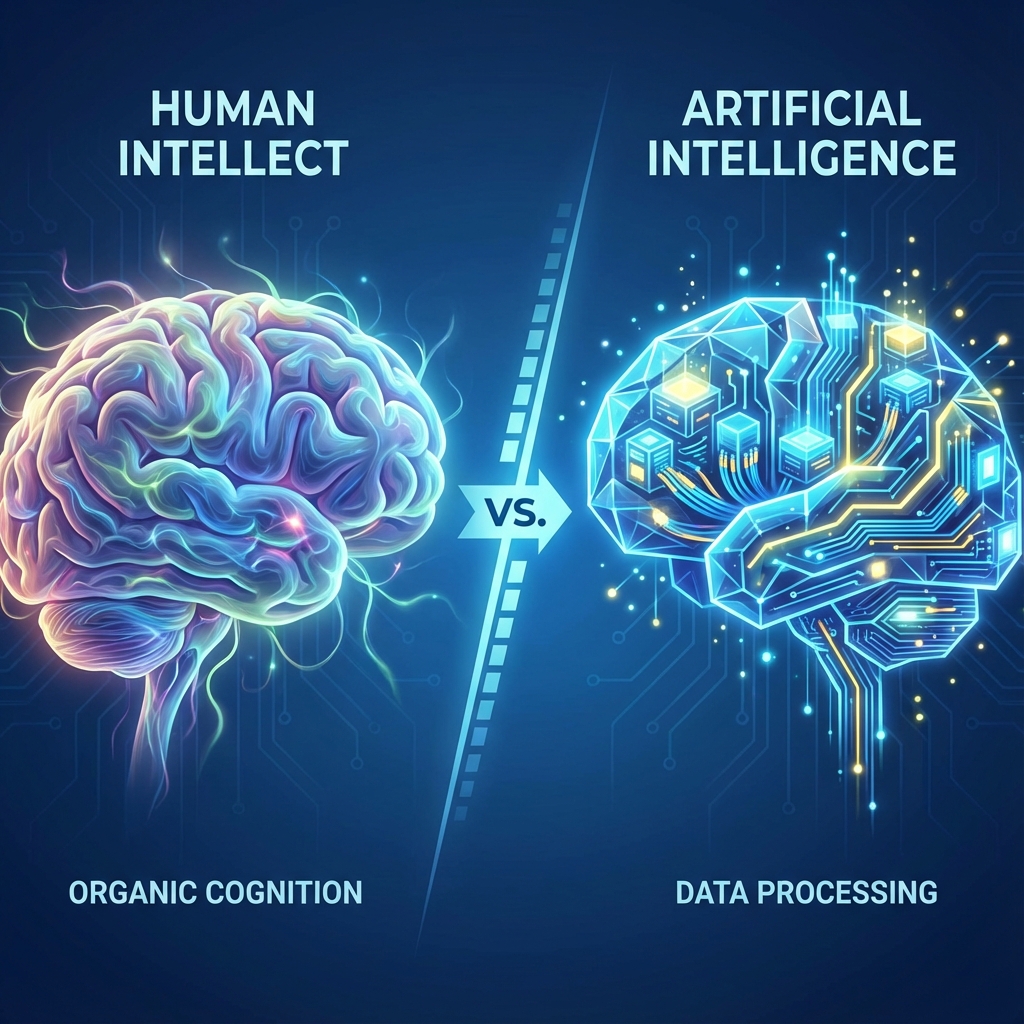
If you turn on the news or open social media, you will hear about Artificial Intelligence (AI). It is everywhere. But if you ask ten different people what AI actually is, you will likely get ten different answers.
Is it a robot? Is it a search engine? Is it a super-brain that will take our jobs?
In this guide, we are going to strip away the sci-fi hype and look at the scientific reality. Here is the deep, clear explanation of what AI really is.
The Core Definition
At its simplest level:
AI = Giving machines the ability to think and act intelligently.
But that definition is a bit too shallow. To be precise, Artificial Intelligence (AI) is a scientific discipline that enables machines to simulate human intelligence.
When we say “simulate human intelligence,” we don’t mean the machine has feelings. We mean it can perform specific cognitive tasks, such as:
- Understanding information (processing text or voice)
- Learning from experience (improving over time without new code)
- Recognizing patterns (spotting a face in a crowd or a trend in stock prices)
- Making decisions (choosing the best route on a GPS)
- Solving problems (winning a game of Chess)
- Adapting to new situations (handling a road closure in self-driving mode)
1. AI is NOT Magic (It’s Math)
The biggest misconception about AI is that it is some kind of mystical digital consciousness. It isn’t.
AI is built on Mathematics + Logic + Data.
Everything an AI system does—whether it’s writing a poem or driving a car—is powered by algorithms and numerical patterns. It does not have emotions, it does not have a “soul,” and it does not have consciousness.
Think of it this way: A calculator isn’t “smart” because it knows 55 x 55 = 3025. It just followed a set of logical rules. AI is similar, just with much more complex rules and massive amounts of data.
2. AI is NOT Just One Technology
You can’t go to a store and buy “an AI.” AI is not a single product; it is a massive umbrella term that covers a combination of many different academic fields.
To build a modern AI system, researchers combine knowledge from:
- Computer Science (The code)
- Mathematics & Statistics (The probability and patterns)
- Neuroscience (Inspiration from how the human brain works - see Module 1.7)
- Cognitive Science (Understanding thinking)
- Data Science (Processing the information)
- Linguistics (Understanding language)
3. AI is NOT “Robots Taking Over”
Movies like The Terminator or The Matrix have given us a skewed view of AI. We often imagine a human-like robot that walks, talks, and plots world domination.
The Reality: Most AI systems today cannot even tie a shoelace.
Current AI is incredibly good at one thing but terrible at everything else.
- An AI that plays Chess cannot tell you the weather.
- An AI that drives a car cannot write an email.
This is the difference between Narrow AI (what we have now) and General AI (what we see in movies). We are masters of Narrow AI, but we are still very far from machines that possess true, human-like general intelligence.
Summary
- What is it? A simulation of human intelligence (learning, reasoning, solving).
- How does it work? Through math, logic, and data—not magic.
- Is it dangerous? It is a powerful tool, but it is not a conscious being plotting against us.