1.10 Your First AI Project: Predicting House Prices
If you’ve made it this far, you might be thinking, “Okay, the theory is cool, but how do I actually build AI?”
Many beginners assume building AI requires thousands of lines of complex code and a PhD in mathematics. That is a myth. Thanks to modern libraries like Python’s scikit-learn, you can build a working Machine Learning model in just a few lines.
Let’s get our hands dirty. We are going to build a simple AI that learns a pattern and predicts house prices.
The Mission: Teach a Computer the Real Estate Market 🏠
Imagine you are a real estate agent. You know that generally, bigger houses cost more money. You have a small notebook with data from four houses you sold recently:
- 500 sq ft = 20 Lakhs
- 600 sq ft = 25 Lakhs
- 700 sq ft = 30 Lakhs
- 800 sq ft = 35 Lakhs
Your goal is to feed this data into a computer so that when a new house comes on the market (say, 750 sq ft), the AI can instantly tell you what the price should be.
The Code (Explained Step-by-Step)
We will use Python, the most popular language for AI. We’ll also use two famous libraries:
- numpy: For handling numbers and data arrays.
- sklearn (Scikit-Learn): A toolkit that contains pre-written AI algorithms.
Here is the complete code:
import numpy as np
from sklearn.linear_model import LinearRegression

# Step 1: Create the Dataset
# This is our "Experience" - the data the AI learns from.
# Note: square_feet is a list of lists (2D array) because models expect multiple inputs.
square_feet = np.array([[500], [600], [700], [800]])
prices = np.array([20, 25, 30, 35])  # Prices in Lakhs

# Step 2: Initialize and Train the Model
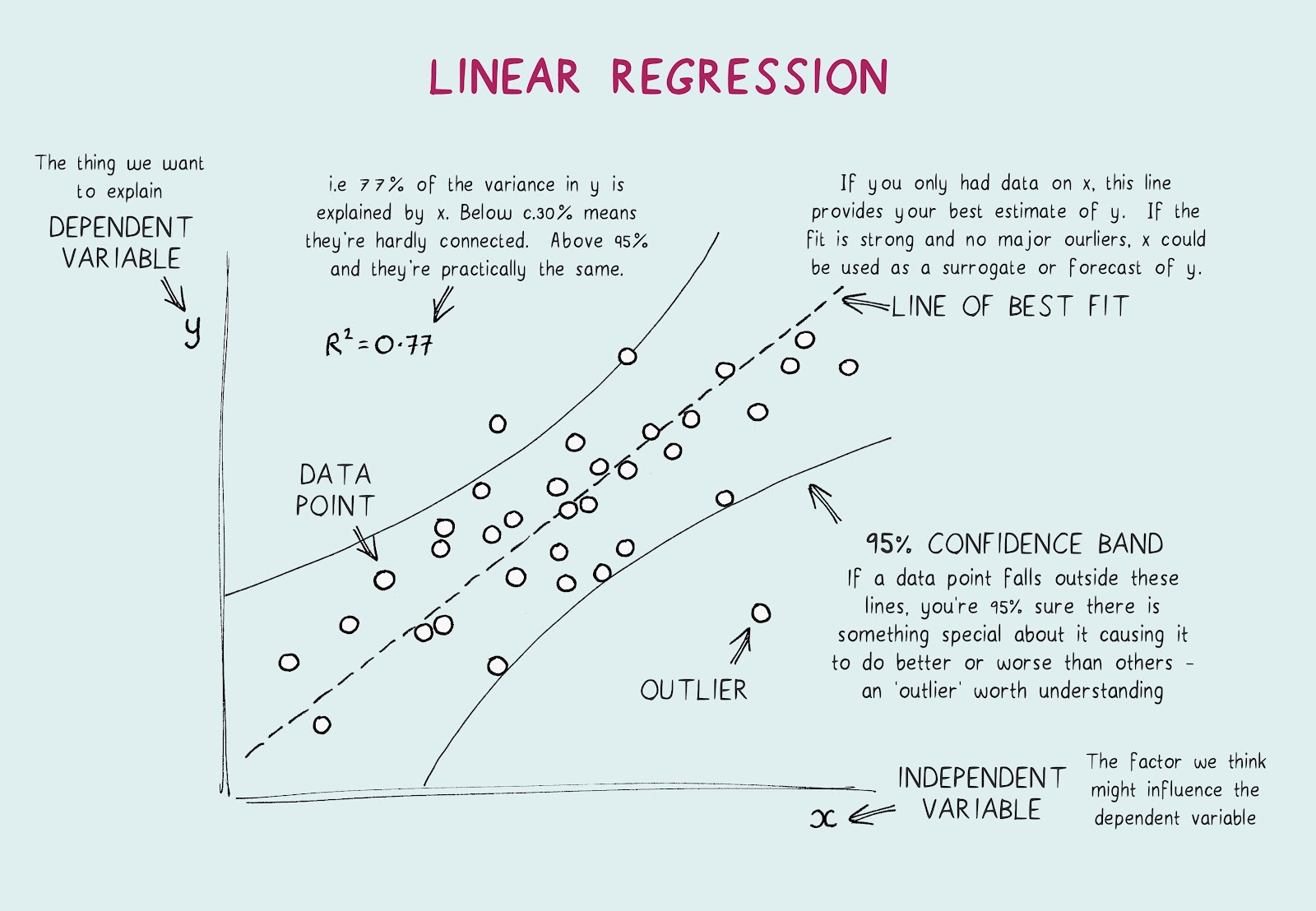
# We choose "Linear Regression" because we are looking for a simple trend (line).
model = LinearRegression()

# The .fit() command is the magic moment.
# This is where the AI looks at the data and "learns" the pattern.
model.fit(square_feet, prices)

# Step 3: Make a Prediction
# Now the model is trained. Let's ask it about a house it has NEVER seen before.
new_house_size = [[750]]
prediction = model.predict(new_house_size)

print(f"Predicted price for 750 sq ft: {prediction[0]} Lakhs")
What Just Happened? 🤯
When you run this code, the computer doesn’t just guess. It performs the AI Lifecycle we discussed earlier:
- Data Input: It takes your numbers.
- Pattern Recognition: The
model.fit()command looks at the relationship between size and price. It realizes, “Aha! Every time the size goes up by 100, the price goes up by 5.” - Inference: When you ask about 750 sq ft, it applies that pattern to give you the answer: 32.5 Lakhs.
Why This Matters
This is a simple example, but it represents the foundation of Machine Learning. Whether it’s predicting house prices, stock market trends, or the weather, the core concept remains the same: Data + Algorithm = Prediction.
You just wrote your first piece of AI code. Congratulations!