1.6 AI vs. Machine Learning vs. Deep Learning
If you listen to tech news, marketing pitches, or casual conversation, you will hear the terms Artificial Intelligence (AI), Machine Learning (ML), and Deep Learning (DL) used interchangeably.
But here is the secret: They are not the same thing.
While they are related, they are distinct concepts with specific meanings. Confusing them is like saying a “Car,” an “Engine,” and a “Ferrari” are the exact same thing.
To understand modern technology, we need to untangle this knot. Here is the clearest explanation of how these three fields fit together.
The “Russian Nesting Doll” Effect
The easiest way to visualize the relationship between these three is to think of Russian Nesting Dolls (Matryoshka dolls) or a set of concentric circles.
- AI is the largest outer doll (the broad concept).
- Machine Learning fits inside AI (a specific subset).
- Deep Learning fits inside Machine Learning (the specialized core).
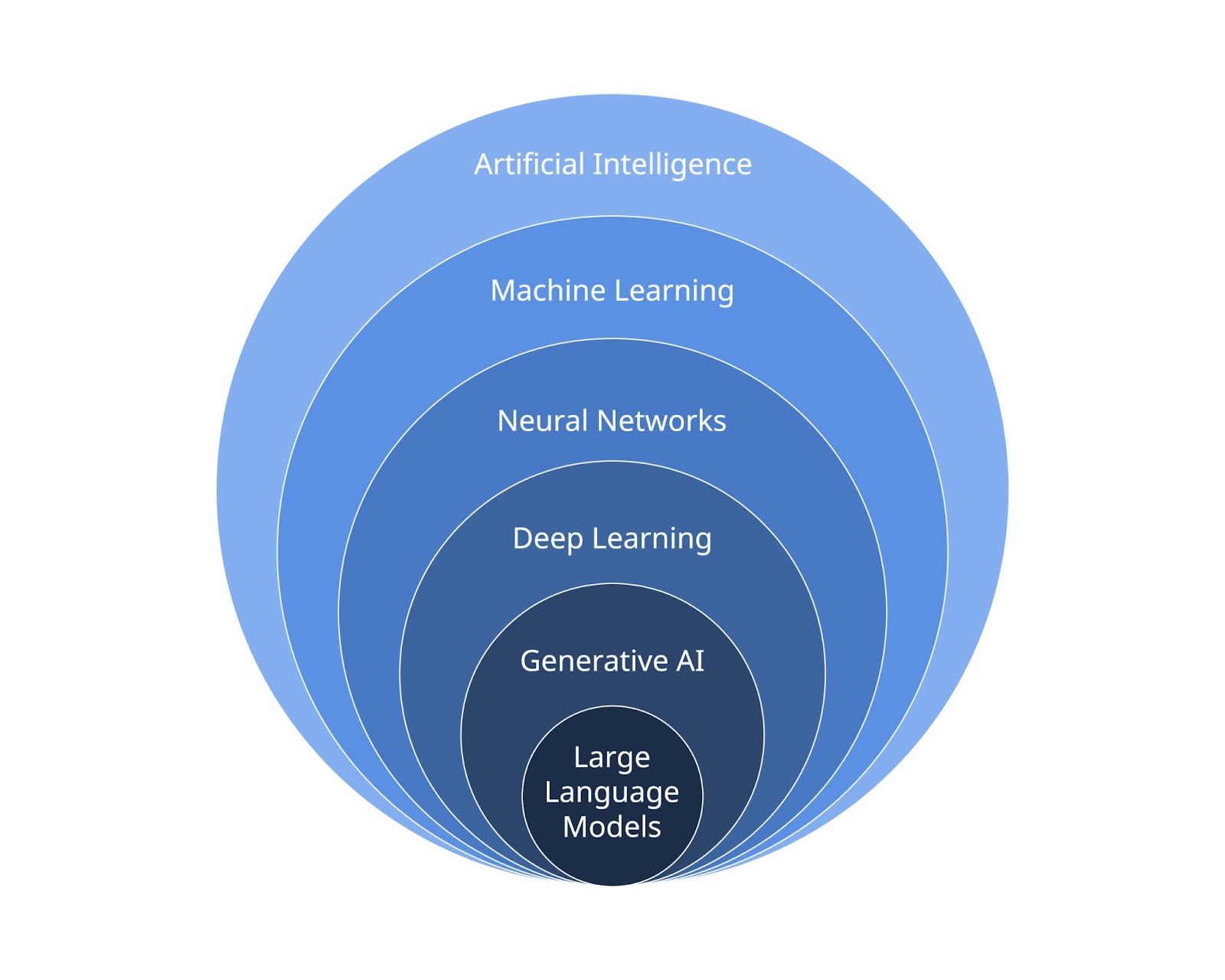
1. Artificial Intelligence (The Big Wrapper)
“The Dream of Smart Machines”
Artificial Intelligence is the broad umbrella term for the entire field. It refers to any technique that enables computers to mimic human intelligence.
This includes:
- Logic
- If-Then rules
- Decision trees
- Learning algorithms
Key Distinction: AI does not necessarily mean the machine learns. In the early days (1950s-1980s), AI was often just code written by humans that followed strict rules. For example, a non-player character (NPC) in a video game might have “AI” that tells it to hide behind a wall if it sees you. It isn’t learning; it’s just following a script.
Simple Definition: AI = Any machine that simulates intelligent behavior.
2. Machine Learning (The Smart Subset)
“Learning from Experience”
Machine Learning (ML) is a subset of AI. It was the massive shift that happened when we stopped trying to tell computers what to do and started teaching them how to figure it out.
In ML, we don’t write rules like “If the photo has whiskers, it is a cat.” Instead, we feed the computer thousands of photos of cats and dogs and say, “Find the pattern.”
Over time, the algorithm improves automatically through experience (data).
Simple Definition: ML = AI that improves automatically by looking at data, without being explicitly programmed for every scenario.
3. Deep Learning (The Powerful Core)
“Thinking Like a Brain”
Deep Learning (DL) is a specialized subset of Machine Learning. It is inspired by the structure of the human brain.
While standard ML algorithms are powerful, they often struggle with complex, unstructured data like images, audio, and text. Deep Learning solves this by using Neural Networks—layers of algorithms that process data in a hierarchy.
Simple Definition: DL = ML that uses multi-layered neural networks to learn from vast amounts of complex data.