1.3 A Complete History of AI
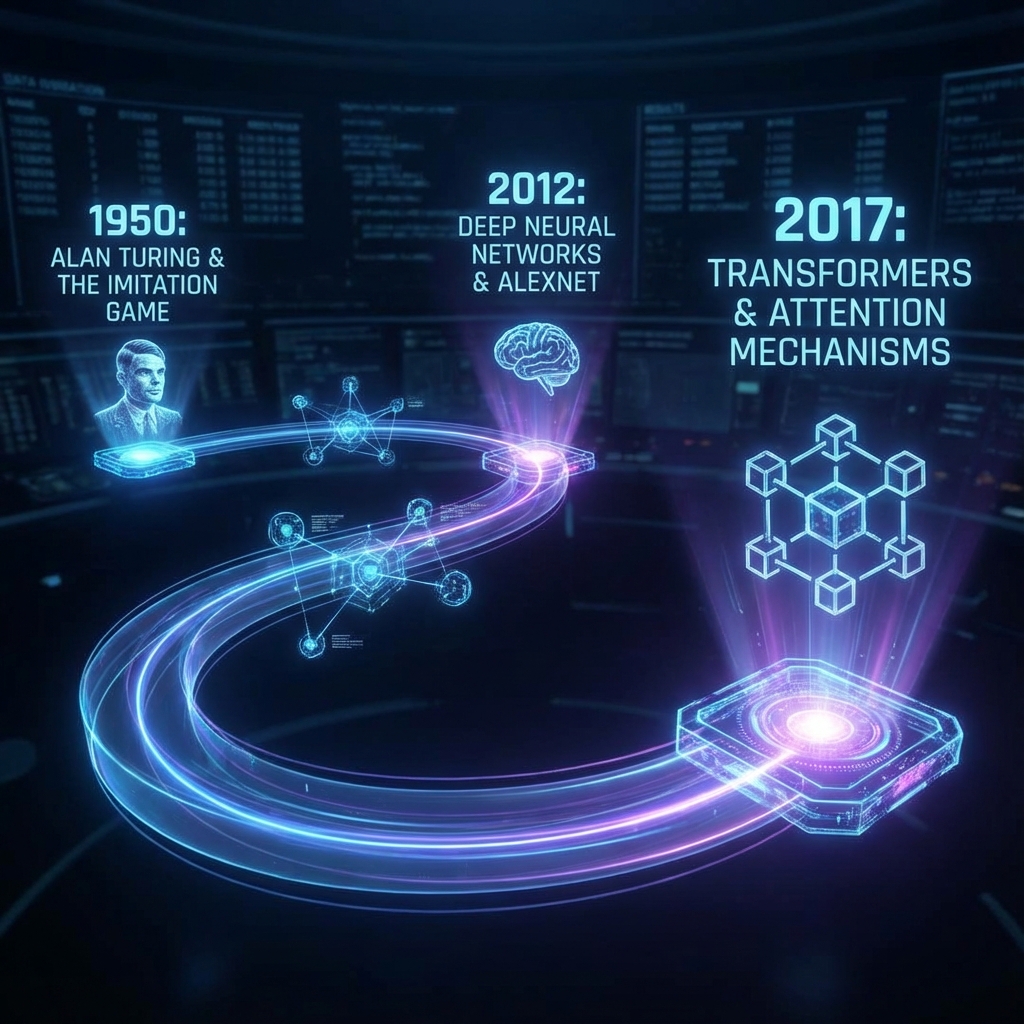
The journey of Artificial Intelligence (AI) is a fascinating story of ambition, setbacks, and incredible breakthroughs. Let’s take a walk through time to see how we got from simple questions to the powerful AI we know today.
1950 – The Birth of a New Idea
The story begins with a question. In 1950, the brilliant mathematician and computer scientist Alan Turing published a paper titled Computing Machinery and Intelligence, in which he famously asked:
“Can machines think?”
To answer this, he proposed the “Turing Test,” a simple yet profound experiment. He suggested that if a human evaluator, in a text-based conversation, could not reliably distinguish a machine from a human, the machine could be considered intelligent.
1960s–1980s – The Era of Rules and Experts
The early decades of AI research were dominated by “Rule-Based Systems.” These systems didn’t learn; they were programmed with explicit rules. The logic was simple: IF condition is true → perform action.
1990s – The Machine Learning Era Begins
The 1990s saw a pivotal shift. AI researchers began to move away from manual rules and towards having computers learn from data themselves. This was the beginning of the Machine Learning era.
Powerful new algorithms were invented, including Support Vector Machines (SVMs), Decision Trees, Bayesian Networks, and early neural networks. This change made AI far more adaptable and powerful.
2012 – The Deep Learning Explosion
The real turning point came in 2012. A deep neural network named AlexNet competed in the ImageNet competition, a contest to recognize thousands of different objects in images. AlexNet won by a huge margin, demonstrating the immense power of Deep Learning.
2017-Present – Transformers and the Modern AI Brain
- 2017: Google researchers publish the “Attention Is All You Need” paper (introducing the Transformer architecture), which becomes the foundation for modern Generative AI like ChatGPT.
- 2022: OpenAI releases ChatGPT, bringing AI to the masses.
Who is considered the 'Father of AI' and proposed the famous 'Imitation Game'?
The Transformer architecture led to the creation of Large Language Models (LLMs) like GPT, BERT, Claude, Gemini, and LLaMA.
These models can understand and generate human language with incredible fluency. They can summarize documents, translate between languages, reason through complex problems, and power the chatbots that are becoming an everyday part of our lives.
From the simple question “Can machines think?” to the sophisticated language models of today, the evolution of AI has been a remarkable journey of innovation. We are now in the era of LLMs, and the story of artificial intelligence is just beginning.