1.4 The 3 Types of Artificial Intelligence
Artificial Intelligence (AI) is one of the most transformative technologies of our time, but it’s not a single, monolithic concept. AI is a broad field with different categories based on capability. Understanding these types is key to grasping what AI can do today and what it might be able to do in the future. Let’s break down the three main types of AI: Weak AI, Strong AI, and Super Intelligence.
1. Weak AI (Narrow AI / ANI)
Artificial Narrow Intelligence (ANI), also known as Weak AI, is the most common form of AI we encounter today. In fact, 99% of all current AI applications fall under this category. ANI is designed to perform one specific, well-defined task. It excels in its designated area but lacks the cognitive abilities to generalize its knowledge to other domains.
A key characteristic of ANI is that it does not “think” in the way humans do. It operates based on a set of pre-programmed rules and algorithms (often using Machine Learning), and its capabilities are strictly limited to the data it has been trained on.
Common examples of ANI include:
- ChatGPT: An AI language model that generates human-like text.
- Midjourney: An AI program that creates images from textual descriptions.
- Siri & Alexa: Virtual assistants that can understand and respond to voice commands.
- Tesla Autopilot: An advanced driver-assistance system.
- Recommendation Engines: The systems used by Netflix and YouTube to suggest content.
- AlphaGo: The first computer program to defeat a professional human Go player.
The robot in the image below perfectly illustrates this concept: it is highly skilled at playing chess, but it cannot perform any other task.

2. Strong AI (AGI) – The Future
Artificial General Intelligence (AGI), or Strong AI, represents a significant leap forward. AGI is a theoretical form of AI that possesses human-like intelligence and cognitive abilities. An AGI system would have the capacity to understand, learn, and apply knowledge to solve a wide variety of tasks, much like a human being.
Unlike ANI, which is limited to a single domain, AGI would be able to generalize its learning and adapt to new and unforeseen situations. It would be capable of reasoning, planning, and creative thought. The development of AGI is a primary goal for many AI researchers (like those at OpenAI), but it is widely considered to be a long-term objective that we are not yet close to achieving.
The robot in the image below visually represents the versatility of AGI, demonstrating its ability to engage in diverse activities like reading a book and playing a musical instrument.

3. Super Intelligence (ASI)
Artificial Super Intelligence (ASI) is the most advanced form of AI, a hypothetical intelligence that vastly surpasses the brightest human minds across all fields, including scientific creativity, general wisdom, and social skills.
ASI would not just be a faster or more powerful version of AGI; it would be a completely different order of intelligence. Its cognitive capabilities would be beyond human comprehension, allowing it to solve problems that are currently impossible for us. The development of ASI is a topic of much debate and speculation, with some experts viewing it as a potential existential risk to humanity.
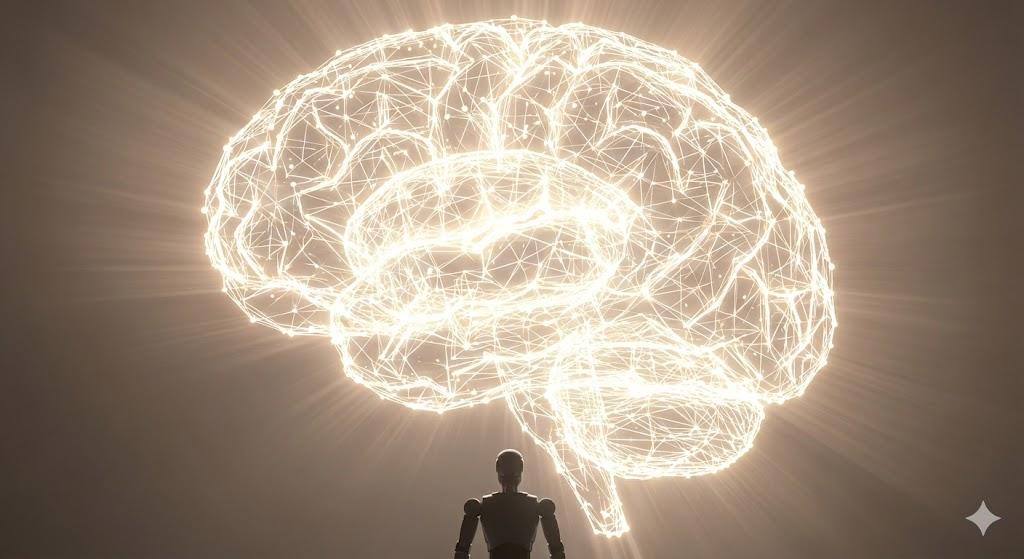
The image below provides a conceptual illustration of ASI, with a colossal, glowing brain symbolizing an intelligence far greater than our own.
In conclusion, while the term “AI” is used broadly, it’s important to distinguish between these three types. We live in the era of Weak AI, with Strong AI as a distant future goal and Super Intelligence as a theoretical possibility. Each step in this journey brings new possibilities and challenges, shaping the future of technology and humanity itself.